
Don't Break, Translate.
How I went from selling stories to engineering signal.

Marketing is many things. A perfectly timed launch. A growth loop. A seven-touch nurture campaign designed to convert. I’ve worked on most of them. Brand plays and product drops. Demo flows and positioning pivots. Respecting tactical marketing is to follow the rhythm of shipping and draw attention to good ideas.
But what keeps my attention is quieter: phrasing that stays with people longer than expected. Lines that moved without needing to be boosted. The messages that held under pressure. Recognition that not everything that performs is durable. How do we spread good ideas that hold shape through change?
Steve Jobs said, “Marketing is about values.” And that in a noisy world, people remember very little—so we’d better be clear about what matters. That’s where I tend to drift, beneath noise, to look for what makes a message resilient: what gives it structure and allows it to travel without falling apart.
To do that, I stepped back. To connect strategy closer to precision. I started treating the message like a product. Something that needs to function across timelines, contexts, and stakeholders. Something that moves through people. Messaging, done well, starts with the wrapper and the present that keeps on giving is the design language— the message scaffolding to identify where we stand.
I’ve worked across product and marketing. So it made sense that eventually I’d start building language like builders prototype—testing for friction, adaptability, and weight. I stopped starting with what would go viral and started asking what would still make sense three months later. I believe depth brings reach, and I want quality to get there first, quantity will show up in dashboards.
In a landscape full of stories, I’m more interested in signal. We’re learning the importance of clarity for language: shape and more importantly meaning. What you hold onto, and orient towards—as things change.
That’s how I arrived at “bend, don’t break.” before rolling solo to Japan. It came out of a writing exercise I used to figure out what’s next in the evolution of messaging with AI. I engraved it on a couple of bracelets—as my quiet behavioral anchor. A phrase I could hold onto when I didn’t have room for more. The metal wore down, the message and personal connections from it, did not.
It works for tension, and for the moments that followed, I needed something to work in motion that I could build with.
The phrase that came next was:
“Don’t break, translate.”
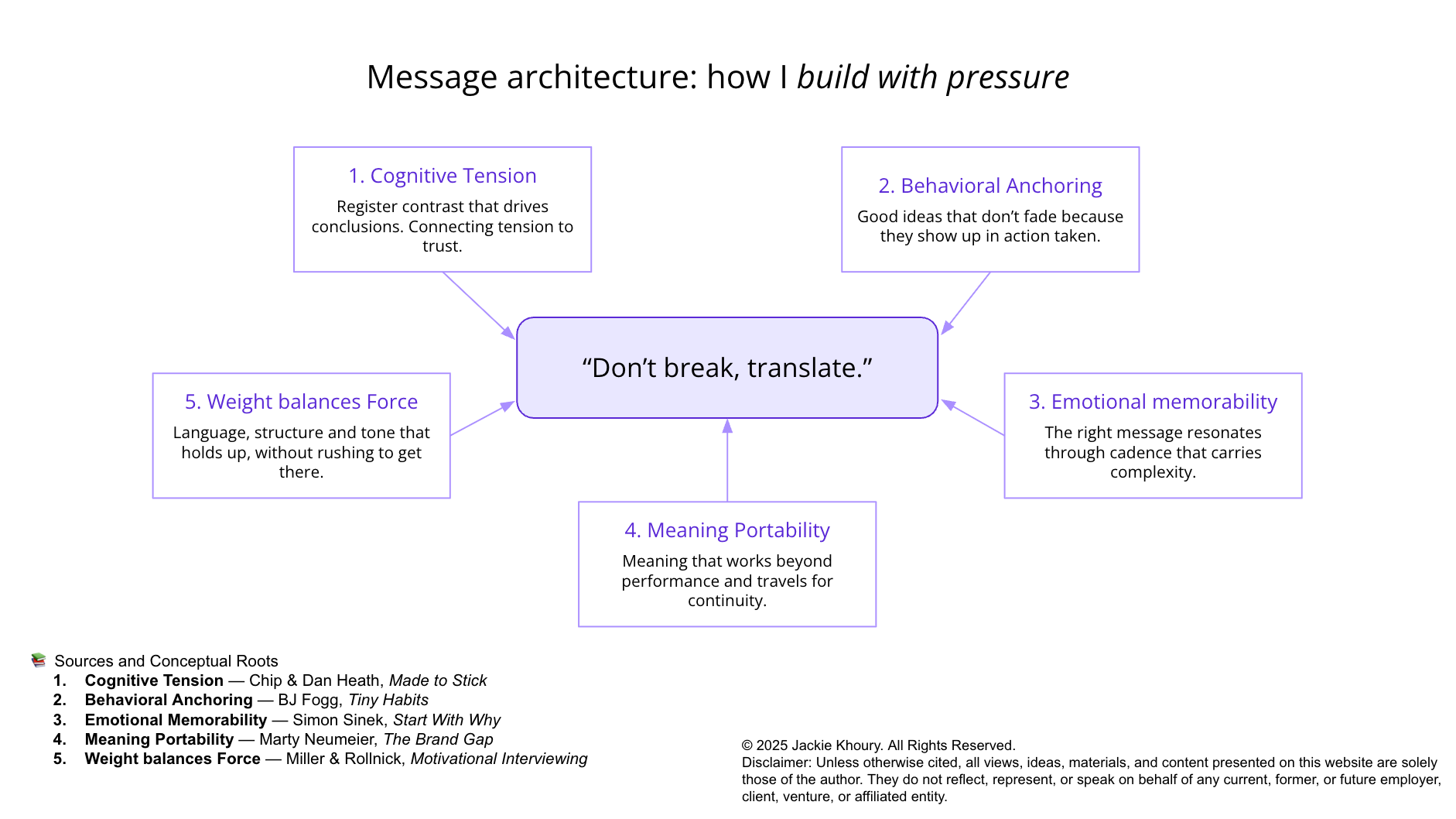
And from that, a message structure framework—as pressure-tested architecture. Five elements backed by behavior science that connect for practical use.
Cognitive tension, drawn from Made to Stick, shows that we register contrast before we register conclusions. Tension, when well-placed, builds trust.
BJ Fogg’s habit model reminds us that motivation is unreliable—so behavior needs clear prompts. Messages need to show up at the moment of action.
Simon Sinek’s “Start With Why” works not because of theory, but because it’s emotionally retellable. What stays in the body isn’t clever—it’s cadence.
Marty Neumeier’s work on brand architecture argues that meaning should stretch beyond performance and move towards continuity.
Miller & Rollnick’s motivational interviewing teaches that familiarity builds trust—while pressure breaks it. Good language holds and doesn’t shove.
These are the elements I use. To simplify through a steady progression of meaning.
I don’t want to break things. So I translate them.
Translation evolves the message by preserving its shape while everything around it moves.
Good strategy orients.
Save it. Copy it. Send it to the friend who’s rewriting a deck at midnight.
Love this, Jackie! Keep writing.